

motion anatomy
Organizing motion.
Chapter 4
The human body consists of many bones, ligaments, muscles, nerves, arteries, and more. Its complexity requires an easy-to-understand organization. For gross, palpatory, functional, and fascial anatomy, classification is generally done by region (i.e., legs, torso, and arms), system (i.e., skeletal and muscular systems), and lines of pull (i.e., posterior and lateral lines).
In motion anatomy, gross anatomy is organized around motion (i.e., flexion-extension, abduction-adduction, and lateral-medial rotation).
Motion, as outlined in chapter 3.1, relates to the XYZ Cartesian coordinate system—a mathematical framework for describing positions in space. In abstract terms, motion refers to a change in position along, or a rotation around, a particular axis (a straight line around which movement occurs). In anatomical contexts, the anatomical planes of motion closely correspond to the Cartesian coordinate system and its axes (Knudson, 2021).
Anatomical planes of motion
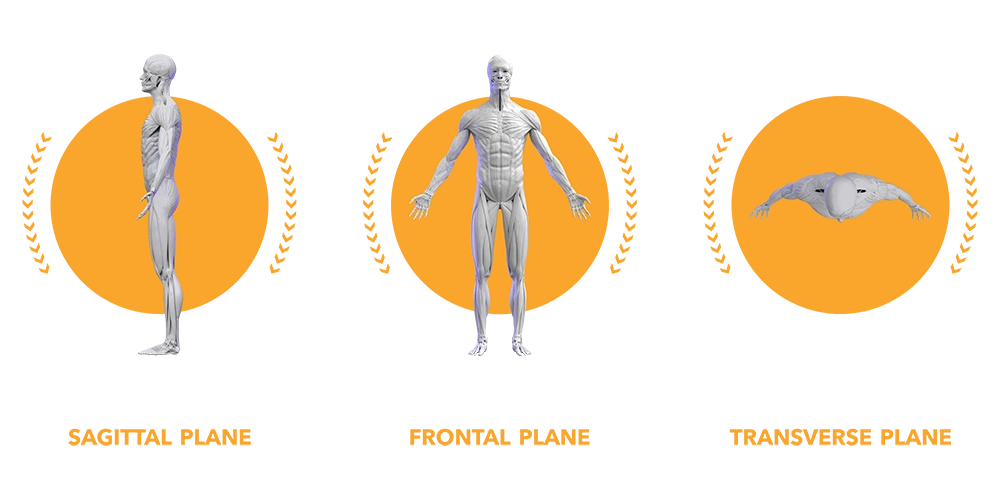
The anatomical planes of motion
The planes, in the anatomical planes of motion, are not the kind of planes you fly in. Instead, this kind of plane is a mathematical idea. A plane is defined as “A flat, two-dimensional surface that extends infinitely, with no thickness.” You can think of it as a huge, but crazy thin sheet of glass.
The anatomical planes of motion are three of these sheets, positioned perpendicular to each other. Applied to the body, the planes divide it into parts, equal or unequal. The first plane is called the sagittal plane; it divides the body from left to right or width-wise. The second is called the frontal plane; it divides the body front to back or depth-wise. And the third is called the transverse plane; this plane divides the body top to bottom or lengthwise. Each plane has an axis that runs perpendicular to the plane it belongs to. The axes are known as the frontal, sagittal, and vertical axes, respectively. Around each axis, within each plane, there are two motions possible, one clockwise and one counterclockwise (Neumann, 2017).
Sagittal plane
Sagittal plane
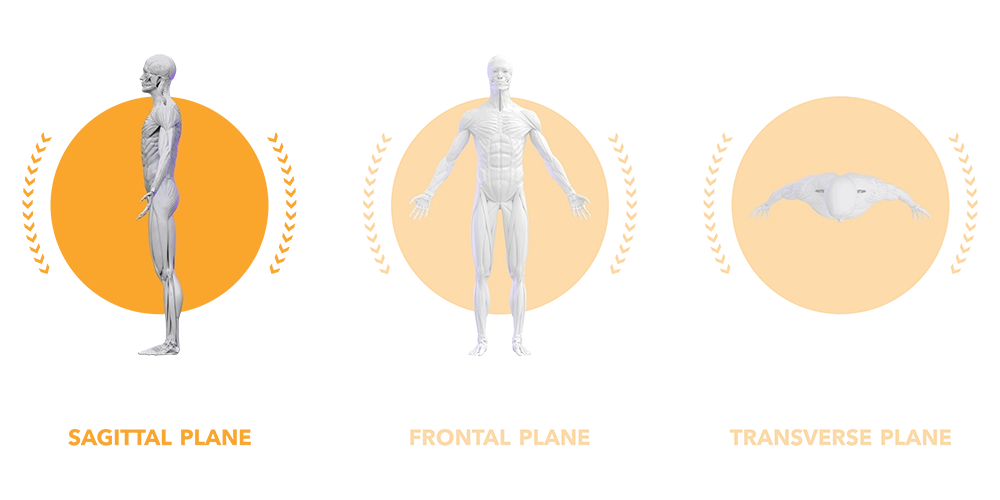
The sagittal plane, also known as the longitudinal or anteroposterior plane, runs front to back and divides the body into a left side and a right side. The axis that belongs to this plane runs left to right and is called the frontal axis.
Motions in this plane and around its axis are generally known as flexion and extension. This includes dorsiflexion and plantar flexion of the ankle, counternutation and nutation of the sacroiliac, elevation and depression of the ribs (pump-handle motion), anterior and posterior tilt of the scapula, and lateral and medial rotation of the abducted shoulder.
Frontal plane
Frontal plane
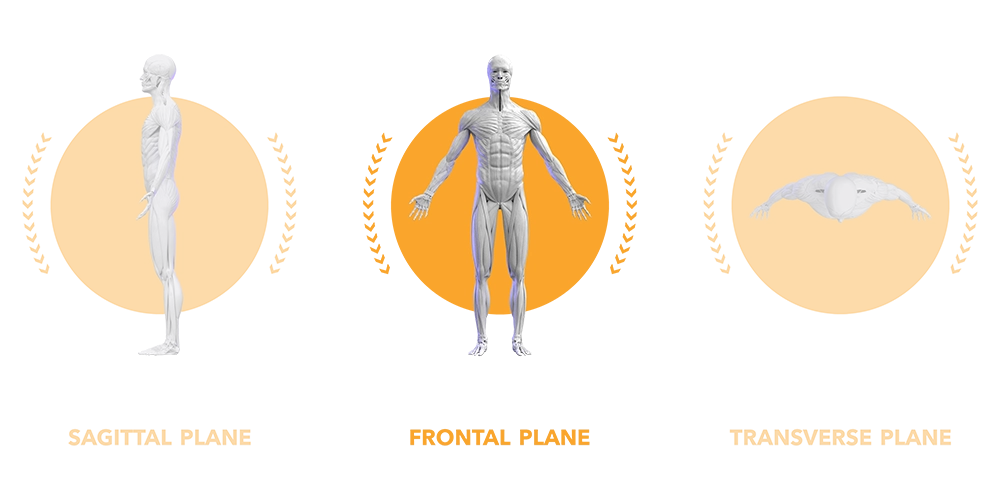
The frontal plane, also known as the coronal plane, runs side to side and splits the body into a front and a back. Its axis runs front to back and is called the sagittal axis.
Motions in this plane and around its axis are often labeled abduction and adduction. This includes ankle eversion and inversion, upward and downward tilt of the hipbones, vertebral lateral flexion, elevation and depression of the ribs (bucket-handle motion), scapular elevation and depression, and scapular upward and downward rotation.
Transverse plane
Transverse plane
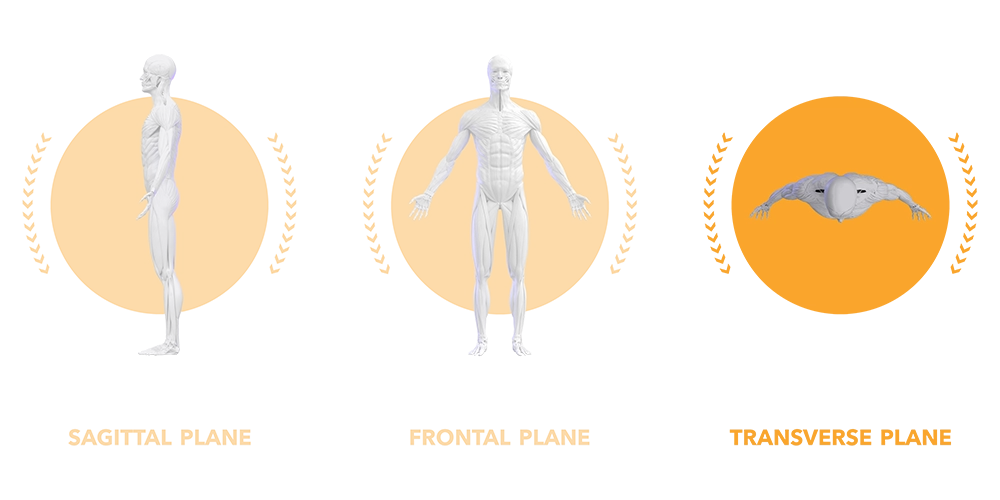
The transverse plane, also known as the axial or horizontal plane, runs horizontally and divides the body into top and bottom parts. The axis that goes with this plane runs top to bottom and is known as the vertical axis.
Motions in this plane and around its axis are lateral rotation and medial rotation. This includes abduction and adduction of the big toe and lesser toes, horizontal abduction and adduction of the hip, scapular protraction and retraction, horizontal abduction and adduction of the shoulder, and pronation and supination of the forearm.

Standard anatomical position
Standard anatomical position
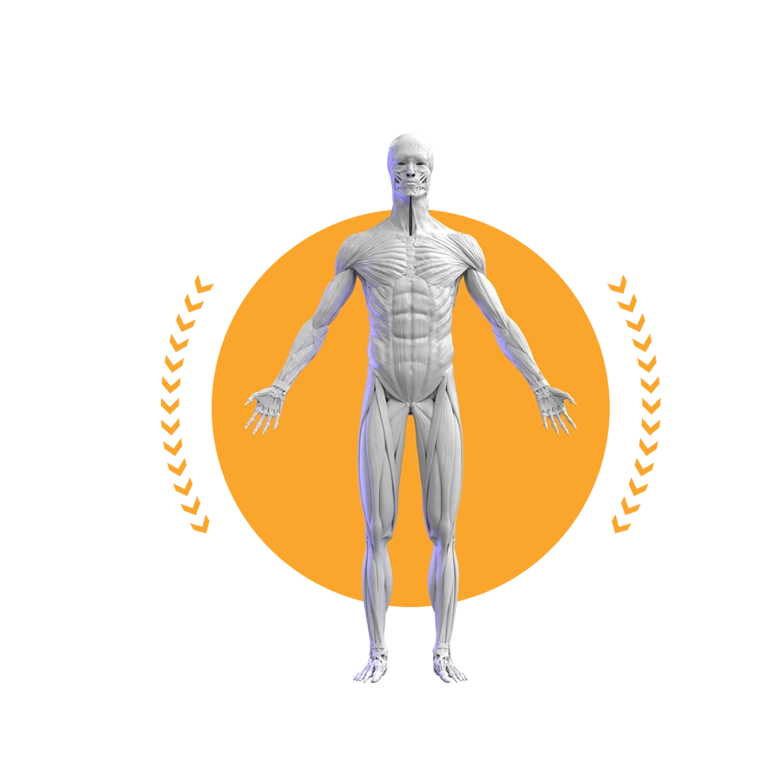
The anatomical planes of motion are, by default, applied to the human body in a standard anatomical position. It is the body upright, facing forward, feet shoulder-width apart, arms at the side of the body with the palms turned forward. All of the illustrations in this book show the body in this position.
The standard position is, of course, nothing like real life. We lie down, sit, stand, and move about freely, whichever way our bodies allow. We do not limit ourselves to one position.
Variable as we may use our bodies, the planes and their axes are a constant. They are in relation to each other and to how they divide the body. Standing or supine (lying on one’s back), in a standard anatomical position, the sagittal plane always splits the body left to right, the frontal plane always divides it front to back, and the transverse plane always top to bottom. We move in relation to the planes, not the other way around. This means that, for some joints, motion can change planes. This happens, for example, with rotation of the shoulder. In the standard anatomical position, shoulder rotation occurs in a transverse plane. But when you abandon the standard position by abducting your arm 90°, like throwing overhead, shoulder rotation moves. Changing from the standard anatomical to an overhead throwing position moves rotation of the shoulder from a transverse to a sagittal plane.
It’s easiest to keep track of through the axes. Axes are always situated perpendicular to their planes. During an overhead throwing motion, the rotational axis of the shoulder runs left-to-right, length-wise through the humerus. The plane located perpendicular to a left-to-right axis is the sagittal plane. So, rotation of the shoulder during an overhead throwing motion happens in the sagittal plane.
Next Chapter
Summary & References
Organizing motion
- Where gross, palpatory, functional, and fascial anatomy organize by structure, region, system, and lines of pull, motion anatomy organizes by motion.
- Motion is described in relation to axes and the Cartesian coordinate system — change in position along, and rotation around, an axis — and the anatomical planes are essentially that same framework.
Anatomical planes of motion
- A plane here is a mathematical idea — a flat, infinitely thin two-dimensional surface, like an impossibly thin sheet of glass — not a physical structure.
- There are three planes, mutually perpendicular: sagittal (divides left/right), frontal (front/back), transverse (top/bottom), each with a perpendicular axis and two possible motions (clockwise and counterclockwise) around it.
Sagittal plane
- Runs front to back, divides left from right; its axis (the frontal axis) runs left to right; its motions are flexion and extension.
- Examples span the body: ankle dorsi/plantarflexion, sacroiliac nutation/counternutation, rib pump-handle motion, scapular tilt.
Frontal plane
- Runs side to side, splits front from back; its axis (the sagittal axis) runs front to back; its motions are abduction and adduction.
- Examples: ankle inversion/eversion, hipbone tilt, vertebral lateral flexion, rib bucket-handle motion, scapular elevation/depression and rotation.
Transverse plane
- Runs horizontally, divides top from bottom; its axis (the vertical axis) runs top to bottom; its motions are lateral and medial rotation.
- Examples: toe abduction/adduction, horizontal hip and shoulder ab/adduction, forearm pronation/supination.
Standard anatomical position
- Planes are applied by default to the standard anatomical position (upright, facing forward, palms forward) — the position all the booklet's illustrations use.
- The planes and axes are constant relative to the body, not to the room: we move in relation to the planes, not the other way around.
- Because of that, a joint's motion can change planes when you leave the standard position — shoulder rotation is transverse-plane in standard position but shifts when the arm is abducted to throw overhead.
Reference list chapter 4
- Knudson, D. V. (2021). Anatomical description and its limitations. In Fundamentals of biomechanics (3rd ed., pp. 49–72). Springer.
- Neumann, D. A. (2017). Kinesiology of the musculoskeletal system: Foundations for rehabilitation (3rd ed.). Mosby/Elsevier.

Publisher
Bad Nut Publishing
ISBN
Motion is an accumulation of everything we are, how we're doing, and how we feel.
Because it is, we can use it practically and clinically.
It allows us to evaluate, quantify, treat, and exercise pain and dysfunction. And improve overall health and wellness. This book is about these basics. It takes the holistic claim and applies it to wellness in general.
Author
Willem Kramer